
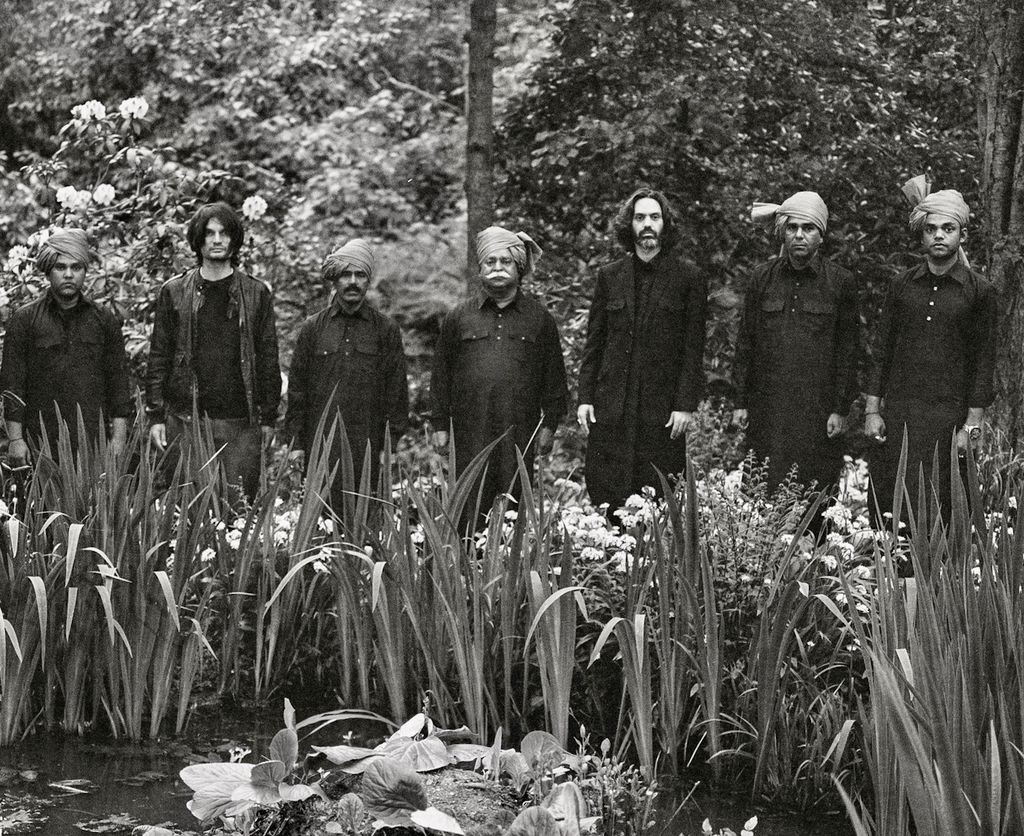
To create 2015’s Junun, Radiohead guitarist Jonny Greenwood, poet-musician Shye Ben Tzur and the Indian folk-music collective The Rajasthan Express decamped to the inner chambers of a 500-year-old desert fortress in India’s mystical blue city of Jodhpur—about as unorthodox a recording studio as you could imagine.
Nearly a decade later, the group finally reconvened to create the project’s second chapter, Ranjha—and Radiohead’s sonic scientist laid out a plan that shocked Ben Tzur.


“We recorded Junun in the most spectacular, inspiring place. I thought I’d found the perfect recipe—let’s never record any other way,” he says today. “But to Jonny, if something works, it means that now you have to do something completely different.”
For Radiohead fans, that decree might feel on-brand—the band’s reinvented its sound and style for decades. And that’s how almost two dozen musicians from three countries found themselves somewhere they didn’t expect—Greenwood’s home studio in Oxford, England.
Ranjha, like Junun, is a wholly unique listening experience—both with deep roots.
The albums are born from Ben Tzur’s reverence for Indian classical music; as a young man, the New York City-born, Israeli-raised musician moved to India to immerse himself in the country’s rich, diverse musical culture. He dug deep—learning Hindi and Urdu, studying Sufi poetry, and even living in the house of Sufi saint Hazrat Nawab Khadim Hasan Gudri Shah Baba III. Ben Tzur released two albums blending Hebrew poetry and traditional Qawwali (a type of Muslim devotional) music before connecting with Greenwood and The Rajasthan Express to create the echoing, enchanting Junun.
For Greenwood, Ben Tzur’s musical devotion and faith felt exciting. It also challenged his Western conception of spiritual music.
“I was raised singing, well speak-singing, inaudible Christian hymns,” says Greenwood. “It’s been so interesting seeing how spiritual music can be made that has real fire, real passion. To be so masculine, too—all these male choirs declaiming the joy of devotion to Sufi saints. But whether it’s Sufi music or Bach, music gets closer than any other art form to expressing spiritual truths. It makes words on their own feel clumsy and ungainly.”
Following Junun’s release, Radiohead took the whole crew on the road in 2017 and 2018—Greenwood’s experimental Hebrew-Sufi project opening for his legendary rock band. But then, just as Ben Tzur and Greenwood began to talk about a follow-up, COVID locked everyone in place. The sudden passing of Zaki Ali Qawwal, one of the central singers of The Rajasthan Express, paused the project further. They’d build momentum towards a recording session and lose it in a breath.
“It’s a big elephant to push uphill,” says Ben Tzur. “We are a lot of people.”
Still, slowly but surely, Ben Tzur collected new compositions—putting Sufi poetry to song and writing his own verses in Hebrew. He spent seasons back in India playing with his Rajasthan Express bandmates, developing new ideas, piling devotional lyrics atop mesmerizing rhythms, with percussive call-and-response vocals.
Ben Tzur resisted sending demo recordings between parties—insisting the music had to develop live, in its own time.
“Of course, I thought it could save time to send tracks and expect everyone to meet and know their part,” he says. “But we are into slow food. This is a slow-cooking process. We have to sit together, to meet and drink chai and eat together, to spend a day or two before we can access the music we want to create.”
That chance finally came in 2022, when schedules and stars aligned, and everyone converged in England. Greenwood’s desire to do things differently wasn’t just a need for perpetual change.
“This time, we decided it was the Indians’ turn to work abroad and get some inspiration from somewhere unfamiliar,” he says. “I wanted to use the studio as an extra instrument that can be used for creativity in itself.”
As the full group began digging into Ben Tzur’s compositions, Greenwood encouraged The Rajasthan Express members to explore all the toys on hand.
“It was wild watching them embrace all these new instruments,” says Greenwood. “Zakir [Ali Qawwal], our harmonium player, began using Moogs and church organs. Aamir [Bhiyani], the trumpet player, raided the local school brass instruments to play euphoniums and pocket trumpets.”
Recording in a more traditional studio effectually allowed the group to get even more out there.
“It’s his playground,” says Ben Tzur. “The studio itself became an ingredient in the dish we were preparing—not just an environment to document the ecstasy of us playing.”
When the sessions were wrapped, it was obvious they’d created something related to Junun—but more cousins than siblings. While Junun is awash in shimmering horns bouncing off the fortress walls, Ranjha is funkier and leaner. But the way Greenwood’s guitar locks in with the traditional hand drums of Ehtisham Khan Ajmeri and Nathu Lal Solanki make these songs just as mesmerizing.
“It’s all in the rhythms for me,” says Greenwood. “It’s like when you listen to Erik B and Rakim or James Brown, the beats carry you along. They are what energizes the words. Though in Shye’s case, instead of hot pants, the lyrics are more about the love of the divine—not that I value differently songs about either subject.”
For Ben Tzur, one additional change gave Ranjha it’s entrancing sound.
While recording Junun, he remembers, he kept his focus towards the sacred shrine of a Sufi saint in Ajmer, 125 miles away. To create Ranjha, he says, “I wondered, ‘What if we sing toward a shrine hanging out there, somewhere in space, a focal point that is moving around the earth?’ And so, in the studio, we’d ask: Are we floating high enough above the earth?”
A listen to these mystical songs reveals an unequivocal: Yes.