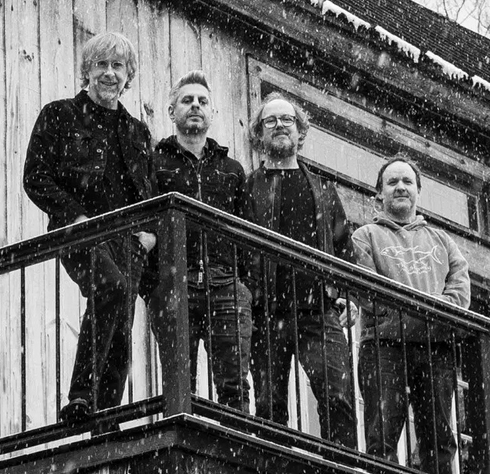
While it will take time to knownif it is truly timeless, Sigma Oasis will always evoke a specific moment.Less than 24 hours after announcing the surprise release of their 15thalbum, in the midst of the novel coronavirus crisis, the band held a virtual“listening party,” in which fans were able to all tune in simultaneously as theystreamed the album across radio and social media platforms. For 66 minutes onan otherwise grim and weird Wednesday evening in April, during a bizarre periodof forced individual isolation, every Phish fan in the country felt connected. Itwas a moment of unity that, for Phish fans, was the subcultural equivalent ofLive Aid or Hands Across America.
At times, Sigma Oasisalmost feels more like unearthed concert recordings than a new studio album.Sure, it benefits from fancy flourishes (strings and backing vocals are laced tastefullythroughout) and overdubs (such as keyboardist Page McConnell’s Vida Blue-like gadgetry), but the quartet recordedthe basic tracks live, in their comfortable Vermont barn headquarters, wherethey were able to improvise while making eye-contact—they were jamming, sansaudience. The live vibe shines as they confidently work their way through thecream of their cache, taking songs like underplayed favorites “Leaves” and“Thread,” and giving them new life on Sigma Oasis.
In recent years, Phish havesounded like they were reaching for something that wasn’t quite there in thestudio, trying to be some band that wasn’t quite them. On Sigma Oasis,Phish sounds like Phish—even in the studio, for the first time since 2002’s RoundRoom (which was also, not coincidentally, recorded live in their studiolair, The Barn).
Previous Phish sometimes sufferedfrom prestigious outside producers that didn’t have a fan’s ear, and theresults—from sterilization to the track lists—betrayed that. Here, all ninesongs read like the setlist to a perfect set of live Phish. The bandco-produced the album with Vance Powell,whose own roots lie in the live-sound world. Artists sometimes refer to albumsas photographs from a certain time and place, but this isn’t a photograph—it’sa goddamn calling card.
By just the third song in,“Everything’s Right,” the band turns the jam knob to 11, stretching out thesong for 12 minutes, and eventually landing in “Type II” territory. Jambands almostalways approach studio versions as a way of establishing a base model, but thestudio version of “Everything’s Right”—and “Thread,” the album’s grand finale—endsup deviating from the standard even more than some live versions, includingvocal flairs that give this permanent on-the-record version a whimsical feel thatisn’t usually heard in the studio.
Phish’s balladry is alsohighlighted with augmented versions of “Shade” and the “Life Beyond a Dream,” acrossover from Trey Anastasio’sGhost of the Forest tour, while the cautionary tale of “Evening Song” earns itskeep in between two oft-requested multi-beast fan favorites, “Mercury” and“Steam.”
Lyrically, Sigma Oasisbridges the gap between lyricist Tom Marshall’s brilliant Rift-erapoeticism and Anastasio’s message-driven content that’s become such a hallmarkof his current songwriting. (This is also Phish’s first album since Farmhouse, 20 years ago, to only featurematerial penned by Anastasio and his writing partners.)
In spite of enormous odds, thisstudio album by a band who isn’t particularly known for their studio albums isable to harness the healing power of music to deliver relief and panacea duringa stressful global pandemic, and it continues to unite a community that is physicallyseparated by social distancing and government orders. Benjy Eisen