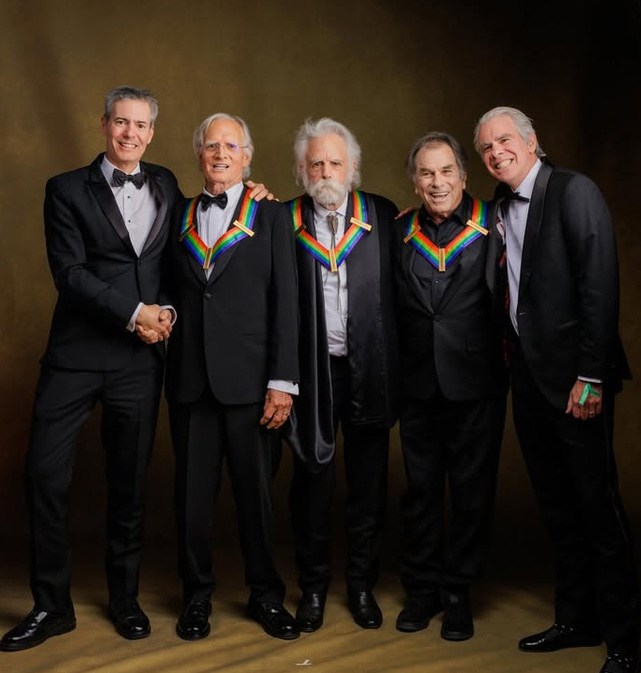
David Lemieux, Bill Kreutzmann, Bob Weir, Mickey Hart and Mark Pinkus at the 2024 Kennedy Center Honors
[This article appears in our special 132-page Bob Weir edition, which presents rare photography, archival interviews and new conversations that pay tribute to an endearing, enduring artist.]


Grateful Dead archivist David Lemieux has occupied his current role for over a quarter century. Prior to his professional association with the group, Lemieux was a Deadhead, taping and trading shows as well as kibbitzing with fellow fans about the music.
Initially hired to examine and catalog the Dead’s video holdings, he took on the overarching position following the passing of Dick Latvala in 1999. Lemieux’s current responsibilities include the band’s annual official box set, the SiriusXM show Today in Grateful Dead History and the Dave’s Picks subscription series.
Lemieux recalls interacting with Bob Weir when the Vault was located near the musician’s home in the Bay Area during the early 2000s. “Bobby was very much a music director on a lot of projects, and he was always asking for different versions of things,” the archivist indicates. “He also might ask me to show the Vault to somebody. I remember showing Mickey and Bobby the Vault with Steve Miller. I also got to spend an hour with Bobby and the Edge in the Vault, just showing the Edge around, who was blown away.
“The nice thing about Bobby is that while it was a 30-year continuum for him with the Grateful Dead, he did have very specific memories of great moments in Dead history—maybe not specific shows but tours in general. For instance, he remembered the summer and fall of ’89 as very good. I remember he once came into the studio while Jeffrey [Norman] and I were working on the Düsseldorf show from ’72, which became an album called Rockin’ The Rhein. He asked, ‘What are you listening to?’ I told him, and after he listened with us for a few minutes, he said, ‘Oh, man, we played like demons on that tour.’”
Lemieux has drawn on his perspective to suggest 10 live Bob Weir songs worthy of your attention. Given the archivist’s enthusiasm and knowledge base, he easily could have recommended alternatives by a factor of 10. He notes, “Many years ago, when I put my first list together of my top 10 or 20 Grateful Dead songs, I realized that a lot of the songs that I gravitate toward happen to be Bobby songs and they’re all so different in the live setting. In putting this list together, there were many versions I could have chosen that would have been major Bob Weir moments, but I went with 10 songs that I love and 10 versions that always get my toes tapping.”
“FEEL LIKE A STRANGER”
(Formerly the Warlocks)
October 9, 1989
Hampton Coliseum, Hampton, VA
When I was started working for the Dead in ’99, Bobby was really ramping up his RatDog activities. They were adding a lot of Grateful Dead songs to the RatDog repertoire, so Bobby would ask me to put together CDs of certain songs that he could pass along to Jay, Jeff and those guys. I would give him a studio version, and he’d also want live versions. When I’d asked him what era he wanted the live versions to be from, he’d say, “Do summer ’89 through spring of ’90.” He specifically asked for those because Bobby remembered that late Brent era as a peak of the Grateful Dead that featured versions of the songs he remembered as being really good.
This version from Hampton is one where Bobby and Brent start singing, “It’s going to be a long, long, crazy, crazy tour.” The fact they were throwing in that stuff demonstrates Bobby’s playful side. He was a prankster at heart and you can hear them having fun. This was a new era for the Grateful Dead, starting a week before, when they brought back “Death Don’t Have No Mercy.” Then this very week they brought back “Help on the Way,” “Slipknot!,” “Attics of My Life” and “Dark Star.” It was a wonderful era for the Grateful Dead, and I feel that this energy carried on through the rest of that tour, with the five Brendan Byrne shows, the Spectrum, the Charlotte shows and then those two amazing Miami shows to wrap it up. That energy continued right through spring of 1990.
“ESTIMATED PROPHET”
(Dick’s Picks 18)
February 3, 1978
Dane County Coliseum, Madison, WI
This version of “Estimated Prophet” just goes places. By the fall of ’77 they had started taking “Estimated Prophet” way out there. It would generally be 10-11 minutes, but this one clocks in at about 13 minutes. It has an expansive jam, then eventually goes into a 15-minute “Eyes of the World.” Bobby’s singing is just magnificent. It’s soaring.
I remember around 2002 we were working in San Francisco with a video editor on one of the View from the Vaults, the Grateful Dead’s DVD releases. This guy was a music lover and musician himself, but he wasn’t a Deadhead. I was sitting behind him at a table while he was in the edit bay. We were working on “Estimated Prophet” and he stopped the song in the middle, then turned around, looked at me, and said, “Is this in 7/4 time?” As Deadheads, we’d just come to accept Bobby’s time signatures, but to other people in the rock-and-roll world, these were atypical. You’re not going to hear 7/4 in a standard rock song. So this guy was blown away but it never occurred to me as being anything out of the ordinary because as a Deadhead, it was normal to us.
“BLACK-THROATED WIND”
(Sunshine Daydream)
August 27, 1972
Old Renaissance Faire Grounds, Veneta, OR
Ace has got eight songs on it, and seven of them became staples of the Grateful Dead repertoire. The exception was “Walk in the Sunshine,” which I also happen to love. That’s where we got songs like “Looks like Rain,” “Playing in the Band” and “One More Saturday Night,” but “Black-Throated Wind” was different from the others. It was a road song, an introspective meditation on America. It seemed like a very serious song. When I started hearing the versions of it from ’72-’74 on live tapes and on Steal Your Face, which is a much better album than people give it credit for being, I just really loved this song. Then in October ’74, they put it away for what we had assumed was forever, before they brought it back on March 16, 1990.
When I look at a Grateful Dead setlist, I don’t really care that much about which songs they play, as long as the show is played well. But when I see “Black-Throated Wind” on a setlist, I perk up a little bit, particularly after they brought it back in 1990 because if Bobby’s singing “Black Throated Wind,” I feel like he’s having a pretty good night. That’s not a song he takes lightly. I don’t want to say it’s a heavy song, but it’s meaningful. It’s a big song. The live versions allow Jerry some space at the end to do some incredible stuff under Bobby screaming that closing bit.
I think that the Sunshine Daydream show, August 27, 1972, deserves all of the hype it gets. It includes songs that I don’t want to call definitive versions, but I would turn people onto them if they ask, “Hey, can you point me to a good version of ‘Bertha’ or ‘China’ > ‘Rider’ or ‘Bird Song’ or ‘Black-Throated Wind?’” I think the “Black-Throated Wind” from this show is perfection. It was a beautiful, hot, sunny day on a field in Oregon, and that was the ideal setting for this song, which has weight to it.
“SUGAR MAGNOLIA”
(Europe ’72)
May 4, 1972
Olympia Theater, Paris, France
I’ve loved this song ever since I first heard it. The first album I heard in late ’83 or early ’84 was Skeletons from the Closet: The Best of the Grateful Dead. I loved the first side, which has “Sugar Magnolia” from American Beauty, along with “Truckin’.” It’s also got “Rosemary,” which I think is hilarious that it’s on a “best of” album.
I was 13 or 14 years old and I was such a neophyte. I’d heard that in the studio the Dead could be a little tame but that those same songs could blow the roof off the place in the live setting. So I love the American Beauty version of “Sugar Magnolia,” but when I heard the Europe ’72 version, it really blew me away. Then shortly afterwards, I saw the Dead play it in the Grateful Dead Movie from 1974, which showed me what an explosive rock-and-roll song it was.
There’s a version from the Greek Theatre on July 13, 1984. That’s the night with the “Scarlet” > “Touch” > “Fire” and the “Dark Star” encore. When Bobby ends the last verse of the song, “Take me out and I wander ‘round…” and before they go into “Sunshine Daydream,” Brent does this keyboard flourish. I remember hearing it for the first time and that’s what really put it to me that “Sugar Magnolia,” a pretty straightforward song, could still vary from night to night.
I remember being in university in Montreal and my friend Jeff, who knew I was a Deadhead, said, “Hey man, how many versions of ‘Sugar Magnolia’ can you possibly listen to?” I was a bit incredulous. I said, “All of them. They’re all different.”
Well, I just mentioned three live versions—Europe ’72, Grateful Dead Movie and then the Greek ’84—and those are three distinctly different versions of the song. So yes, the answer is I can listen to them all because they’re all very, very cool.
“MY BROTHER ESAU”
(Dick’s Picks 36)
March 26, 1987
Hartford Civic Center, Hartford, CT
I’ll start by pointing out that this was my first Grateful Dead show, when I was 16 years old. “Brother Esau” was one of the songs that I loved, and what I loved about “Esau” is that it could start in different ways. It could start with a big explosive beginning or it could start with a little bit of drums and then Bobby would come in and start singing.
It debuted in the spring of ’83 and if you look at setlists over the next four years, it was around a lot. Then in the fall of ’87, they just dropped it and it never returned. Thankfully, Bobby did end up playing it occasionally with Wolf Bros and Furthur. But “Brother Esau” was always played so differently. I think the best way to describe it is quirky.
They recorded and mixed a great version for In the Dark, but it wasn’t included on the album. It was the B-side on the “Touch of Grey” single and it was included on the In the Dark cassette but not the vinyl.
It’s a song that I loved, and I was fortunate to see it at three of my first six shows, which would make one think, “Alright, I saw it at three of my first six shows. I’m going to get ‘Esau’ a lot throughout my whole life.” Then I never saw it again with the Grateful Dead.
“BORN CROSS-EYED”
(Road Trips Vol. 2 No. 2)
February 14, 1968
Carousel Ballroom, San Francisco, CA
I love the early ’68 sound. There are so many good shows from late January through mid-March, when they were recording the live shows that became the pieces that would end up as part of Anthem of the Sun. When you listen to the shows from late January through mid-March, you’ll hear little snippets that you know very well from that album.
“Born Cross-Eyed” is a rare Bobby song in which he wrote both the words and the music. It strikes me as a perfect 1968 primal Dead song that is very much of its time. Then, when they brought it back at Alpine in 2002 with The Other Ones at the Grateful Dead Family Reunion, I remember thinking, “This song is absolutely timeless.”
The Grateful Dead only played it for that brief period when Mickey had just joined in the fall of ’67 and they started writing all these great new songs. Then Anthem of the Sun came out in ’68, and the song was gone. So it was very much of its time because of that, but when you listen to those versions after they did bring it back, it doesn’t sound like a 1968 song. It always puts a smile on my face.
“LOOKS LIKE RAIN”
May 6, 1978
Patrick Gymnasium, Burlington, VT
“Looks Like Rain” is a song that I feel is almost always really good. It’s also a little different in the different eras it was played. You can think of those beautiful versions in June of 1976, when Bobby and Donna are really feeling those unbelievable vocal harmonies. Then in 1978, the song builds to something where the ending crescendos become bigger and more explosive.
I always love “Ship of Fools,” but some versions go from the lower, almost ballad-like tempo to more of an explosive, almost rock-and-roll song, where you’re like, “This is ‘Ship of Fools.’ How can this be?” The same thing happens in this “Looks Like Rain.” It is a monster. This is a “Looks Like Rain” that I feel should get more attention.
I first heard this show when I started working for the Dead. The April ’78 tour is a beast, then they took 10 days off and came back for the second part of the tour in May, which I love. We have no plans to release this show because we don’t have a ’78 coming up anytime soon, but you never know.
This “Looks like Rain” is truly one of the best. There’s another great version from Egypt in September of ’78, but this one’s a dandy and worth checking out.
“THE OTHER ONE”
(Dick’s Picks 23)
September 17, 1972
Baltimore Civic Center, Baltimore, MD
When I started working for the Dead, I had access to all of these tapes that I had never heard from my tape-trading days because there were no soundboard recordings that circulated, including this one. The tour had so many good shows, including the Philly Spectrum show that became Dick’s Picks 36. This Baltimore show was one of those nights where every song in the first set was played magnificently—both the smaller songs, as well as “Playing in the Band,” “Bird Song” and the bigger jams.
Then the second set has an “Other One” that clocks in at around 36 minutes. That’s one of the longest versions but what’s interesting about it is not just the quantity, it’s the quality. It goes into so many different types of jams. It’s almost a trio with Phil, Keith and Billy, then Bobby and Jerry are not only doing incredible “Other One” things but also some incredible harmonics.
Bobby’s doing some wild stuff on the guitar, and that’s when you realize that as much as Bobby is called a rhythm guitar player, he most certainly is more of a second lead player. He found a new way to play guitar, and you’ll hear it on this “Other One” because he is all over the place doing a counterpoint to what Jerry, Phil and Keith are doing. Then it gets so deep that you forget there are still two verses in this song that Bobby delivers perfectly. I’ll sometimes put this one on as sort of a meditative aid where I can go deep into it and then come out of it 36 minutes later with a fully fresh perspective on the day.
“VICTIM OR THE CRIME”
(Dick’s Picks 40)
July 19, 1990
Deer Creek Music Center, Noblesville, IN
I remember getting a tape in 1987, and it was from May of 1986, when Bobby went to New York City for a solo acoustic show at the Saint, which was previously the Fillmore East. It was the first time I’d ever heard Bobby do an acoustic set like this. He was playing “Throwing Stones” and songs like that but then came “Victim or the Crime.” This was before the Dead started playing it on June 17, 1988. It’s interesting that Bobby had been kicking around this song going back to 1983 with Bobby & The Midnites.
When it came into the Grateful Dead repertoire, it was an interesting song that initially didn’t have a big jam at the end, but by the fall of ’88, they started adding these more expansive jams out of it. This version is from Deer Creek in ’90, but if you listen to the one from Deer Creek in ’89, a full year earlier, that’s when you start hearing “Victim of the Crime” going way out there.
It was one of the Grateful Dead’s final, later-era songs that had weirdness in it. When you think of Grateful Dead later-era stuff, you think of “So Many Roads,” “Lazy River Road,” “Liberty” and “Days Between,” along with Bobby’s “Easy Answers” and “Eternity.” These are all wonderful songs, but they don’t have this level of going way out there. For a first-set song in particular, “Victim of the Crime” could have these huge meltdowns. On this one, Phil is doing some really deep low-end stuff, then Jerry, Bobby and Brent are making some wild sounds. It gets so far out there that it’s almost like a “Dark Star” or “The Other One” level of weirdness. This is one of the meltiest of the meltdowns of the later era.
“PLAYING IN THE BAND”
November 18, 1972
Hofheinz Pavilion, Houston, Texas
I’m going to give credit to Dick Latvala on this one—my friend and mentor and predecessor and boss. I was very fortunate. I joined up with the Dead team in February of 1999 and Dick was around until August of that year. For a good few months, I worked virtually every day in the Vault with Dick. I was cataloging the video collection—organizing, barcoding and all that stuff—while Dick was doing his Dick’s picking. With Dick, we’d get pretty deep because as much as this is music, it’s art. Of course, it was also a lot of fun. We’d listen to a lot of Grateful Dead, and he’d ask me about my favorite songs, eras and years.
I told him that I really loved “Playing in the Band.” I loved the jams it started taking by the end of the Europe ’72 tour, when it started clocking in at around 15 minutes, and I also loved the later ’72, ’73, ’74 versions. Then he said, “Oh, do you know Houston ’72?” I told him I knew the second night, the November 19 show with that big “Dark Star” and he asked me if I knew the November 18 “Playing in the Band.” I said, “No, I don’t think I know that one.”
So he put it on from the master reels on the Vault’s Meyer speakers. There was a couch in the Vault, and he sat me down, then left. Dick would often do that. He’d put something on and then he’d leave because he wanted people to have their own experience with the music.
So I sat there for 25 minutes, and when Dick came back into the Vault, my jaw was on the floor. It was such an inspired version. Every time the Dead would conclude a jamming idea, they didn’t pause and ask, “Where do we go now?” Instead, they instantly, seamlessly went into where they were going. It’s driving and deep and it hits many peaks without any hard stops. It’s like butter.